
Article | July 21, 2026
Normal Tissue Biology: Closing a Critical Blind Spot in Drug Target Selection
Clearly the emphasis of proteomics in oncology drug development centers upon assaying the tumor: using the data to identify the drivers of malignancy, localize therapeutic targets, and measure drug response. However, this focus leaves a systematic gap with direct clinical consequences: a compelling tumor target may still carry unknown risk to healthy tissue, and without characterizing that protein’s expression in normal tissue, its viability as a therapeutic target cannot be adequately assessed.
With on-tumor, off-tissue toxicity representing a leading cause of dose limitation, clinical holds, and program failure, normal tissue biology is often a blind spot that current target selection workflows are not built to close: it is addressed as a downstream clinical problem to be managed after a candidate is already in the clinic, rather than as an input to target selection itself.
Why Normal Tissue Expression Matters
For modalities in which the drug payload is delivered upon binding to specific protein targets on the cell surface, such as antibody-drug conjugates (ADCs), radioligand therapies, and T cell engagers, selection of tumor-specific targets is critical. If the target is highly expressed on tumor cells, but also appears on normal tissues such as the heart, lung, liver, or kidney, the drug may bind and release into healthy organs. To ensure a viable therapeutic window, the target must not only be abundant enough to drive effective payload delivery, but also sufficiently selective to tumor tissue relative to normal tissues.
Even when drug development programs prioritize analysis of normal human tissue protein expression as part of early target identification, they are often relying on gene expression databases or transcriptomic data from normal tissue collections. The limitation of these datasets is that an antibody binds a protein, not an mRNA transcript – and transcript and protein abundance are often moderately correlated, at best, in disease and treated states. Therefore RNA-based normal tissue assessments can fail to capture this risk when the transcript-to-protein correlation for a given target is poor. Resolving this requires characterizing normal tissue expression directly at the protein level.
The DynamiQ™ Normal Human Tissue Proteomics Atlas
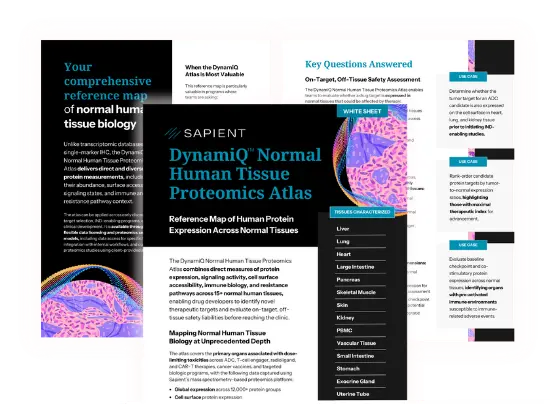
Sapient has developed a pre-characterized reference dataset of normal human tissue proteomes, generated via the same high-throughput mass spectrometry platform used for our tumor proteomics workflow – which measures more than 12,000 proteins groups per tissue sample, including post-translational modifications (PTMs) such as glycosylation and phosphorylation. This normal tissue protein atlas spans tissue types relevant to oncology safety assessment, from lung and heart to exocrine glands and skin, and enables direct comparison between tumor and normal tissue protein expression within a single analytical framework.
This has substantial practical value. When a target emerges from a tumor proteomics experiment, the corresponding normal tissue comparison is available immediately, without the need to design and run a separate normal tissue study.
The comparison is also analytically consistent: both datasets are generated on the same platform under the same conditions, making differential expression estimates directly interpretable. Comparing tumor mass spectrometry data against RNA expression data from a public database mixes measurement types and introduces systematic uncertainty.
Applications of a Normal Tissue Protein Atlas in Target Selection
Normal human tissue proteomics data supports target selection decisions at multiple stages of a drug development program.
ADC and surface-directed therapy target prioritization
After tumor surface antigens are identified using cell surface proteomics, normal tissue expression profiling identifies which candidates have favorable tumor-to-normal protein ratios. This narrows the target list prior to antibody development, directing resources toward candidates with a genuine safety margin rather than surfacing normal tissue liabilities after substantial investment.
Safety prediction
Proteins with high abundance in normal heart, kidney, or liver tissue are poor candidates for cytotoxic payloads, independent of tumor expression. Normal tissue proteomics identifies these risks at an early stage, when they are least costly to address.
Therapeutic window estimation
The combination of tumor abundance and normal tissue abundance yields a protein-level estimate of the selectivity ratio available for a given target. This is a more realistic input for preclinical safety modeling than RNA-based estimates, as it reflects the protein levels that an antibody or other binding agent will actually encounter in both tissue types.
Indication selection
Some proteins exhibit favorable tumor-to-normal ratios in specific cancer types but not others. Profiling normal tissue expression alongside tumor data across multiple cancer types enables indication prioritization based on measured protein-level selectivity rather than assumed cross-indication consistency.
Beyond Oncology: Normal Tissue as a Biological Reference
The utility of a normal tissue protein atlas extends beyond oncology safety assessment. In any disease program, characterizing a protein’s expression in healthy tissue establishes the biological baseline against which disease-state measurements can be compared.
In cardiometabolic disease, for example, normal tissue references distinguish adaptive from pathological protein expression changes. In CNS drug development, normal brain tissue protein data establishes baseline expression prior to disease onset. In autoimmune programs, comparison of inflamed to uninflamed tissue at the protein level is interpretable only against a normal baseline. Pre-characterized normal tissue proteomics reduces the time and cost of establishing these baselines for each new program.
Illuminating a Blind Spot in Drug Development
With normal tissue proteomics, programs can move from assumption to direct measurement in their safety assessments. A target’s risk to healthy tissue is knowable at the protein level well before a candidate reaches the clinic, and the earlier that risk is visible, the more it can inform target selection rather than dose de-escalation. Illuminating that blind spot is what turns normal tissue biology from a late-discovered liability into an early part of how a target is evaluated.